AI-Assisted Software Development Trends
Artificial intelligence is transforming how software is designed, written, tested, and maintained. Instead of replacing developers, AI tools are enhancing productivity, improving accuracy, and accelerating innovation cycles across organizations of every size. From automated code suggestions to intelligent testing frameworks, AI-assisted development is reshaping the modern engineering workflow.
Businesses that understand these trends are better positioned to deliver faster releases, reduce technical debt, and build more reliable digital products. This article explores the most important AI-assisted software development trends shaping the future of engineering teams.
The Rise of AI as a Development Partner
AI is no longer limited to experimental tools or research environments. It now functions as a practical development partner that supports engineers throughout the software lifecycle.
Modern AI development assistants can:
- generate code snippets
- detect bugs during writing
- recommend architecture improvements
- automate documentation
- suggest optimization strategies
These capabilities allow developers to focus more on solving complex problems rather than repeating routine tasks.
The result is a shift from manual-heavy workflows to collaboration between engineers and intelligent systems.
AI Powered Code Generation Is Becoming Standard
One of the most visible trends in AI-assisted development is automated code generation. Developers increasingly rely on AI systems to accelerate implementation without sacrificing quality.
Code generation tools help with:
- boilerplate creation
- repetitive logic structures
- API integrations
- test scaffolding
- configuration setup
Instead of writing every component from scratch, developers guide AI systems that produce structured code aligned with project requirements.
This trend shortens development cycles and improves consistency across teams.
Intelligent Debugging Is Reducing Development Time
Debugging traditionally consumes a significant portion of engineering time. AI-powered debugging tools now identify issues earlier and recommend fixes automatically.
These systems analyze:
- runtime behavior
- syntax patterns
- dependency conflicts
- logic inconsistencies
- performance bottlenecks
By detecting problems during development rather than after deployment, AI reduces costly delays and improves product stability.
Early issue detection also supports faster iteration cycles.
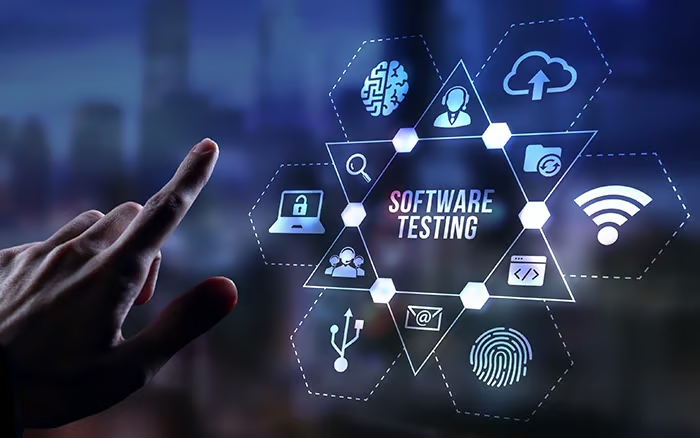
Automated Testing Is Becoming More Adaptive
Testing frameworks are evolving from static scripts to adaptive AI-driven environments that learn from system behavior.
AI-assisted testing tools can:
- generate test cases automatically
- prioritize high-risk areas
- simulate user interactions
- detect regression risks
- identify edge case vulnerabilities
Adaptive testing ensures higher coverage without increasing manual workload.
Organizations benefit from improved reliability and reduced production incidents.
Natural Language to Code Interfaces Are Expanding Access
Another important trend is the growth of natural language programming interfaces. Developers can describe functionality in plain language and receive structured implementation suggestions.
This approach supports:
- rapid prototyping
- faster onboarding for new developers
- improved collaboration between technical and nontechnical teams
- simplified experimentation with new ideas
Natural language interfaces are making development workflows more intuitive and accessible.
They also reduce barriers for interdisciplinary collaboration.
AI Assisted Documentation Is Improving Knowledge Sharing
Documentation is essential but often neglected due to time constraints. AI systems now help generate and maintain documentation automatically during development.
These tools can:
- summarize functions
- explain architecture decisions
- generate usage examples
- update outdated documentation
- maintain consistency across repositories
Improved documentation strengthens team communication and supports long term maintainability.
This trend is especially valuable for distributed engineering teams.
Predictive Code Completion Is Enhancing Productivity
Predictive completion tools analyze context to suggest entire logic blocks rather than individual keywords.
These systems consider:
- project structure
- naming conventions
- dependency relationships
- previous coding behavior
- team standards
Developers spend less time typing repetitive structures and more time refining application logic.
This shift increases both speed and accuracy.
AI Driven Security Analysis Is Becoming Essential
Security vulnerabilities often originate during development rather than deployment. AI-powered security analysis tools identify risks before they become production threats.
Security-focused AI systems detect:
- injection vulnerabilities
- unsafe dependency usage
- exposed credentials
- insecure authentication logic
- configuration weaknesses
Embedding security checks directly into development pipelines reduces exposure to attacks.
This trend supports safer software delivery without slowing innovation.
Smart Refactoring Tools Are Reducing Technical Debt
Technical debt accumulates when legacy code becomes difficult to maintain. AI-assisted refactoring tools help modernize codebases efficiently.
These systems can:
- identify redundant structures
- recommend architecture improvements
- optimize performance bottlenecks
- replace outdated syntax
- simplify complex logic paths
Smart refactoring keeps applications scalable without requiring full system rewrites.
Organizations benefit from improved long term sustainability.
AI Assisted DevOps Is Accelerating Deployment Pipelines
Deployment workflows are becoming faster and more reliable through AI-assisted DevOps automation.
AI enhances DevOps by:
- predicting deployment risks
- optimizing pipeline configurations
- monitoring system behavior after release
- detecting infrastructure anomalies
- recommending rollback strategies
Continuous delivery environments become more stable when supported by intelligent monitoring.
This allows teams to release updates confidently and frequently.
Personalized Developer Workflows Are Emerging
AI systems increasingly adapt to individual developer preferences and habits.
Personalized development environments can:
- recommend relevant libraries
- adjust interface suggestions
- prioritize useful documentation
- highlight common errors
- automate repetitive workflows
Customization improves efficiency and reduces friction in everyday engineering tasks.
Developers spend more time creating solutions and less time navigating tools.
AI Is Transforming Legacy System Modernization
Modernizing legacy systems is one of the most challenging tasks organizations face. AI tools now support structured migration strategies.
These tools assist with:
- dependency mapping
- architecture analysis
- compatibility evaluation
- modernization recommendations
- incremental refactoring strategies
Legacy modernization becomes more predictable and less disruptive.
Organizations can preserve critical systems while adopting newer technologies.
Collaboration Between Humans and AI Is Reshaping Engineering Culture
AI-assisted development is changing how teams collaborate internally.
Instead of replacing engineers, AI supports:
- faster brainstorming cycles
- improved problem exploration
- shared technical insights
- knowledge transfer between team members
- reduced onboarding time for new hires
Engineering culture is evolving toward partnership between human expertise and intelligent automation.
This collaboration strengthens innovation capacity across organizations.
Responsible AI Usage Is Becoming a Development Priority
As AI adoption increases, organizations must ensure responsible implementation practices.
Responsible development includes:
- validating generated code
- maintaining transparency in automation usage
- protecting proprietary data
- preventing dependency overreliance
- ensuring compliance with organizational policies
Responsible adoption ensures AI remains a productivity enhancer rather than a risk factor.
Long term success depends on balanced integration strategies.
AI Supported Architecture Planning Is Improving Scalability
Architecture decisions shape long term product success. AI tools now assist teams during early planning stages.
These tools analyze:
- workload patterns
- scalability expectations
- infrastructure requirements
- integration complexity
- system performance predictions
Better planning reduces redesign costs later in the development lifecycle.
Teams make informed decisions earlier in project timelines.
The Future Direction of AI Assisted Software Development
AI-assisted development is moving toward deeper contextual understanding rather than simple automation.
Future systems will likely:
- interpret project goals more accurately
- coordinate across development tools automatically
- predict maintenance requirements
- optimize performance continuously
- support cross platform architecture decisions
Organizations that adopt these technologies early gain stronger competitive advantages.
AI is becoming a permanent component of modern engineering ecosystems.
Frequently Asked Questions
How does AI assisted development affect developer job roles
AI changes how developers work but does not eliminate their importance. Engineers shift toward higher level problem solving, architecture planning, and system strategy.
Can small development teams benefit from AI assisted tools
Yes. Smaller teams often benefit the most because automation reduces workload and enables faster delivery with fewer resources.
Is AI generated code reliable enough for production environments
AI generated code can support production use when reviewed carefully and tested according to organizational quality standards.
What skills should developers learn to work effectively with AI tools
Developers should strengthen architecture knowledge, prompt design strategies, system thinking skills, and testing expertise to collaborate effectively with AI systems.
Does AI assisted development increase dependency on specific platforms
Some tools integrate closely with certain ecosystems, but many AI solutions remain platform flexible and adaptable across environments.
How can organizations evaluate which AI development tools to adopt
Organizations should assess integration compatibility, security practices, customization flexibility, and workflow alignment before selecting tools.
What role does AI play in improving cross team collaboration
AI improves collaboration by summarizing technical changes, documenting workflows automatically, and supporting shared understanding across distributed teams.